Showing posts with label Ojibwe. Show all posts

May 01, 2013

Ojibwe People's Dictionary

Online Ojibwe Dictionary Launched by University of MinnesotaFor those interested in the Ojibwe language, they now have access to an online Ojibwe-English dictionary.

The University of Minnesota's Department of American Indian Studies launched a groundbreaking online Ojibwe dictionary, the Ojibwe People's Dictionary, at ojibwe.lib.umn.edu. Several Ojibwe elders contributed to the development of this unique dictionary.

“This sets the standard for how indigenous languages will be learned and preserved into the future,” said James A. Parente, Jr., dean of the College of Liberal Arts.

The Ojibwe People's Dictionary was conceived as a logical expansion of "A Concise Dictionary of Minnesota Ojibwe," published by the University of Minnesota Press and co-written by John D. Nichols, professor in the American Indian studies department and one of the foremost Algonquian language experts. The printed dictionary contains 7,000 words, but the new website has 8,000 words and could grow to 30,000.

January 10, 2013

Preserving Ojibwe hymns

Preserving Ojibwe hymns means more than religious devotion

By Dan GundersonMusic is a time honored part of worship in most religions. For many Ojibwe people in northern Minnesota, hymns are much more than an expression of religious devotion. They represent a unique piece of Ojibwe culture tribal that members are trying to preserve.

White Earth Tribal Chair Erma Vizenor, one of the singers at the service, said it's critical to keep the Ojibwe language alive.

"This is one way we can keep it," she said. "We can use it, we can share it, we can build community with it."

Vizenor grew up with Ojibwe hymn singing and traditional spiritual practices. She remembers neighbors gathering in her grandparents' tiny two-room home to sing, and her grandparents explaining traditional ceremonies.

Although Christian clergy tried to end traditional Indian spiritual practices, Vizenor said, the native-language hymns the church brought the reservation have become part of the complex Ojibwe culture.
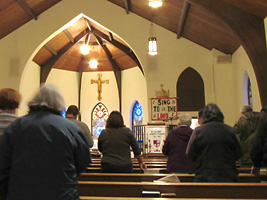
Below:  "Parishioners gather for a service at St. Columba Episcopal Church in White Earth, Minn. on Thursday, Jan. 3, 2013." (MPR Photo/Dan Gunderson)

March 12, 2012

Ojibwe People's Dictionary

Homeroom: University of Minnesota helps create online Ojibwe People's Dictionary

By Mila KoumpilovaGerri Howard was loath to let a digital recorder capture her voice for a new kind of dictionary.

A fluent speaker of Ojibwe on Minnesota's Leech Lake Reservation, she didn't like how she sounded on playback. But the sense of urgency she and other Ojibwe speakers share about their endangered tongue prevailed.

With help from elders such as Howard, a University of Minnesota professor and students have created the first online talking dictionary of Ojibwe. The effort involved crisscrossing Minnesota and Wisconsin to record the voices of the dictionary and brainstorm entries for new-fangled concepts such as "Internet" and "school dance."
And:In tandem with the Minnesota Historical Society, the university lined up a roughly $375,000 Clean Water, Land and Legacy Amendment grant for the project.

Going digital opened up many possibilities: Users can search definitions using both Ojibwe and English. The authors were eventually able to include 30,000 entries, compared to 7,000 in Nichols' "A Concise Dictionary of Minnesota Ojibwe." Most importantly, Childs said, "You click on a word, and you hear Ojibwe people actually speaking the language."

The dictionary also is a virtual museum of sorts, with photos, drawings and texts from the Historical Society collection complementing the entries. But the new format was also an adjustment.

January 13, 2012

Ojibwe documentary wins Emmy

Native Language Documentary Emmy Tours Participating SchoolsLast September, First Speakers: Restoring the Ojibwe Language, a documentary funded through Minnesota’s Legacy Amendment, was awarded a MidWest Regional Emmy for Artistic Excellence in the Documentary-Cultural category.

The golden statuette recently visited one of the many organizations featured in the one-hour film, the Niigaane Ojibwemowin Immersion School on the Leech Lake Reservation near Bena, Minnesota.

“Niigaane kindergarten through sixth grade classrooms participated in the film during late spring of 2010,” said Leslie Harper, the school’s director. “At Niigaane, all academic and social content is taught through the medium of Ojibwe language. In this way, the Leech Lake communities hope to reclaim the Ojibwe language as a vital, necessary language for the coming generations. In order to revitalize and maintain a language, it must be spoken and used by all generations in a community.”

The Emmy is currently on a “Miigwech Tour” to all of the sites that participated in the film. First stop was the Niigaane school, where Harper said the Niigaane students took care of the award and “talked about the importance of our language in today’s world.” The award was at Niigaane until January 6.
Below:  "Niigaane Ojibwemowin Immersion School is located on the Leech Lake Reservation near Bena, Minnesota."

December 29, 2011

Erdrich sisters' Ojibwe-language press

Literature the Ojibwe Way: Erdrich Sisters’ Wiigwaas Press Helps Preserve Ojibwemowin

By Konnie LeMayIn 2008, Heid and Louise Erdrich, both authors and sisters from the Turtle Mountain Band of Chippewa, founded the Birchbark House Fund “to support the work of indigenous language scholars and authors,” Heid Erdrich told Indian Country Today Media Network. In 2010 the two created Wiigwaas Press to publish books solely in the Ojibwe language. Heid oversees the day-to-day operations. Wiigwaas, or birch bark, seemed an appropriate name; the durable bark once served as the medium for delivering messages.

“That was our original writing material for the sacred literature as well as the personal stories,” said Erdrich. “Birch bark was also used for messages such as, ‘We went thataways.’ It was the ‘sticky notes’ of the Ojibwe.”

The sisters first discussed a need for an Ojibwe-language press when Louise helped Mille Lacs Band elder Jim Clark write his autobiography. In 2002 she published that book, Naawigiizis, The Memories of Center of the Moon, through her Minneapolis bookstore, Birchbark Books.

“James Clark has written both in English and in Anishinaabemowin,” Heid Erdrich said. “But the language doesn’t translate precisely.”
Below:  "From left, sisters Heid, Louise and Angela Erdrich enjoy some time together. Heid and Louise are authors and have created Birchbark House Fund to support indigenous language scholars and authors and Wiigwaas Press to publish Ojibwe-language books. Dr. Angela Erdrich, a pediatrician at the Indian Health Board in Minneapolis, is on the national board of Reach Out and Read." (Marian Moore)

December 17, 2011

Porcupine books in Ojibwe

Mom Turned Author Creates Aboriginal Children’s CharacterFaced with two sons learning to read and no dual-language books at her disposal, Emilie Corbiere took matters into her own hands. She created Porcupine, a “grumpy sourpuss” who trots through the world having adventures and making friends.

“There just didn’t seem to be anything out there for my children,” she told the Canadian digital magazine MuchMoreCanada.com. “I looked in bookshops and in the library and couldn’t find what I was looking for. I made up my mind to create a character that children could relate to but that could also be written using the Ojibwe language.”

What sets the series apart is that each book contains four Ojibwe words that are repeated throughout the story, by way of teaching a bit of language as kids learn to read.

November 21, 2011

Ojibwe home movies

New home movies resurrect endangered Native American language

Educator develops multimedia tools to share, preserve Ojibwe language.

By Science NationMon

With support from the National Science Foundation (NSF), Hermes is combining the skills of native speakers with video technology to help others, young and old, learn the language in the most natural way. She's doing it by videotaping short movies of everyday situations, from going to a rummage sale to planting a garden to helping out a sick relative.

"Because Ojibwe isn't spoken on a regular basis, there's not a store or a rummage sale or a resort, but part of what we're doing is trying to re-envision what that would be like," explains Hermes.

"So imagine if Ojibwe was the language of commerce, the language of everywhere you went; everything you did was in Ojibwe," she says.

"What we are hoping is that you hear it in an everyday way, [with phrases like] 'tie your shoes,' 'get up,' 'hey mom what's for breakfast,'—that kind of informal speaking ... that's not necessarily correct formal grammar, but the way you would speak it," she says.

Once those short movies are transcribed by native speakers, they are combined with vocabulary lists, pronunciations, and interactive games to create educational DVDs.

September 14, 2011

Ojibwe book is Minnesota's Best Read

AWESIINYENSAG, Wiigwaas Press, and the Minnesota's Best Read for 2011This is terrific news! Awesiinyensag, a book published by Heid and Louise Erdrich's Wiigwaas Press, was selected as Minnesota's Best Read for 2011. That means the book will represent the state of Minnesota at the National Book Festival in Washington D.C.

As you might glean from reading the title, the text is not in English. Here's the blurb:Awesiinyensag presents original stories, written in Anishinaabemowin, that delight readers and language learners with the antics of animals who playfully deal with situations familiar to children in all cultures. Suitable for all ages, this book can be read aloud, assigned to classes, shared at language tables, gifted to elders, and enjoyed by those curious about the language and all who love Anishinaabemowin.

Authored by a team of twelve and richly illustrated by Ojibwe artist Wesley Ballinger, Awesiinyensag will be the first in a series created to encourage learning Anishinaabemowin, the language of Ojibwe people.
(Excerpted from Debbie Reese's American Indians in Children's Literature, 9/7/11.)

July 25, 2011

Ojibwe signage spreads in Bemidji

Bemidji's Ojibwe Language Project Seeks to Make Effort Irreversible

Permanent Signage Posted by Sanford Health, Schools, OthersMany businesses and organization are trying new things with Ojibwe words demonstrating permanence, creativity, and fun. Beaver Books and others are using portable street ad signs to get their message across. Business owner Brian Larson had his business name translated into Ojibwe Mezinibii'igaadegin Wenizhishingin (Amity Graphics).

Noemi Aylesworth of the Cabin Coffeehouse, (the first business to post Ojibwe/English signage) has headings on menus written in Ojibwe, such as Dekaagamingin (Cold Drinks), Gitigaanensan (Salads), Gigizhebaa-wiisining (Breakfast), and more.

The Sanford Center has "Permanent" Ojibwe/English bi-lingual signage. All doors coming and going at the Sanford Center says Boozhoo (Hello) and Miigwech (Thank you) respectively. There are twelve pairs of restrooms in Sanford Center, each posted with permanent signage with Men/Ininiwag or Women/Ikwewag. And the parking lot has animal images with names in both languages to help you find your car.

Last but not least, Bemidji State University continues to be a leader in this effort by posting first class permanent Ojibwe/English signage throughout both campuses. Bemidji State Park, Itasca State Park, MN DOT, and the DNR are also participating along with over 130 other businesses and organizations.

"One of our concerns when soliciting businesses and organizations to post bi-lingual signage, was permanence," noted Meuers. "We wanted plastic, vinyl, or metal; we are hoping paper signs are only temporary. We are so excited, with Sanford Health, the schools, BSU, and others demonstrating leadership in posting permanent signage...and more. With efforts like this and the new creativity being shown, Bemidji will surely soon be known for its Ojibwe/English signage."
Comment:  For more on the subject, see Bemidji Businesses Post Ojibwe Signs.

Below:  "Principal Drew Hildenbrand points out a sign that says, "Greetings, welcome to Bemidji Middle School."

June 23, 2011

Camp teaches all things Ojibwe

Language camp teaches more than words

By Jana PetersonThis weekend’s Nagaajiwanaang language camp in Sawyer promises more than Ojibwe vocabulary words and spelling lessons. The four-day camp itself will be a lesson in all things Ojibwe, from attitude to native crafts to cooking Indian corn soup with ashes, plus canoe races and other contests that teach skills valued by the traditional Ojibwe culture.

It’s the third year for the camp, which organizers say fills a need in the American Indian community in northern Minnesota and beyond.

“There is a thirst for the language,” said Pat Northrup of Sawyer, one of the driving forces behind the camp. “I hear people in the community more in the last few years–since Fond du Lac made Ojibwe the official reservation language–talking about ‘what’s the word for this,’ learning the language. We’re providing resources.”

In addition to having a total of seven fluent speakers of Ojibwe, the camp will have language books for sale for the first time. There will be designated locations where only Ojibwe is spoken, and other activities–like Arne Vainio’s Mad Science presentations–at which an Ojibwe speaker will translate the English spoken by the presenter.

May 15, 2011

Dakota and Ojibwe doomed?

Working Group Says Dakota and Ojibwe Language Survival is QuestionableIn 2009, the Minnesota State Legislature established a volunteer working group to “develop a unified strategy to revitalize and preserve indigenous languages of the 11 federally recognized American Indian tribes in Minnesota.” That group turned in its report, Dakota and Ojibwe Language Revitalization in Minnesota in February.

The first key finding listed is that Dakota and Ojibwe languages are in “critical condition,” because the population of fluent and first speakers—who were raised speaking the language—is small to begin with and many don’t have teaching credentials.

The working group recognizes the importance of revitalizing American Indian languages because they are “more than grammar and vocabulary. They are inseparable from American Indian identity. Languages express, reflect, and maintain the connections of people to one another and to the world around them. They are shaped over millennia by communal experience, and they shape how a people come to know who they are and what is true, where they came from, where they live, and how the world around them works materially and spiritually.”

But the group fears that assaults on Native culture in general may mean it’s too late for the languages. They say the survival of Dakota and Ojibwe languages “remains a question. After centuries of assault, indigenous languages require heroic life-saving measures on many fronts.”

April 15, 2011

Ojibwe Language Quiz Bowl

A Friendly Competition in Ojibwemowin

By Konnie LeMayIt is expected that about nine teams and 150 students from mainly Minnesota and Wisconsin will attend the event, hosted this year by Augsburg Indigenous Student Association.

During the fast-paced, timed tournament, the four-member teams won’t have too much time to get stuck on pondering. They must quickly answer questions about Ojibwe language definitions, pronunciations and translations. “The content is all what we cover in our classes,” Jones said.

The language bowl, said this year’s organizer Jennifer Simon who directs American Indian Student Services at Augsburg, helps to give students a goal and a focus for their studies. “They want to learn their language…this brings some intentionality to it.”

The language bowl is one tool used to engage students who rarely get to speak Ojibwe outside the classroom. Language tables, regular weekly gatherings where Ojibwemowin is spoken, often over a meal, have also blossomed.

January 17, 2011

Nanabush videos teach Ojibwe

Walking and Talking with NanabushThe Ojibwe Cultural Foundation invites you to walk and talk with Nanabush. Nish Tales: Walking and Talking with Nanabush is a language learning and story sharing site for kids and adults wishing to learn Ojibwe. Nanabush’s humorous escapades and great adventures have entertained generations of Anishnaabe and helped preserve our language. Nish Tales: Walking and Talking with Nanabush is a web site created to do the same. Here we use the humourous adventures of Nanabush to help people learn some basic Ojibwe.

There are two Nanabush stories now on the site: The Power of the Skunk and Nanabush Loses the Meat. The stories are presented as animated clips, text and audio files . All media is in a bilingual format for reading, listening and watching.

More entertaining stories of Nanabush and more language learning content will be added in the coming months.

Who Is Nanabush?

Nanabush is the main character in many Ojibwe legends and is as old as the Ojibwe language itself. He was sent to teach the Anishinaabeg how to live. His mother was Anishinaabe-kwe and his father a spirit. Being half spirit he had amazing abilities. But being half human, he had the virtues and flaws that people have and often could not control his humanly wants and needs.

Nanabush could be selfish or generous; cowardly or brave; caring or spiteful; always curious and mischievous and often his own worst enemy. Sometimes he daringly saved the Anishinaabek, other times he caused them everlasting hardship. Nanabush walked all over Turtle Island. His many humorous escapades and great adventures explained the natural world, entertained generations of Anishnaabe and helped preserve the Ojibwe language. He remains an important figure in Anishnaabe culture. Nish Tales: Walking and Talking with Nanabush looks at the humourous and fun side of some of his adventures.
Comment:  The videos use limited, cartoon-style animation. The watercolor backgrounds are nice, as are the sound effects and music. The tales are cute and short enough to hold one's attention.

All in all, I'd say these videos are an effective teaching tool.

January 07, 2011

Multimedia Ojibwe translations

New online resources offer Ojibwe, English translations

Shared Vision member Michael Meuers is “absolutely psyched” about what was unveiled Monday.

By Anne Williams
Shared Vision member Michael Meuers is “absolutely psyched” about what was unveiled Monday.

Ojibwe translations for nearly 100 English phrases common to Northern Minnesota are now available online and on campus at Bemidji State University and Northwest Technical College.

The multimedia materials, which include paper form and audio clips, are part of a collaborative effort between Shared Vision and BSU. Shared Vision is an organization dedicated to improving relations between American Indians and non-Indians in the community.

A poster designed by BSU’s Office of Communications and Marketing provides a list of English words and their Ojibwe equivalents in nine categories such as “Expressions,” “Trees” and “North Country.”

July 12, 2010

Ojibwe high-school classes

Teaching Ojibwe language beneficial to Duluth students

Ojibwe language, like all Native languages, has as its foundation the truths, values and spiritual ways of our people.

By Linda LeGarde Grover
I was one of many students who took Spanish from Senorita Rich during her years teaching at Denfeld. We learned to read and write a little Spanish, as well as speak. We listened to Rich’s always-interesting stories about her trips to Spanish-speaking countries, and she told us what she observed and tried of their customs and cultures. We made up Spanish dialogues about going to school, shopping, and visiting relatives. We sang popular songs that Rich loved, and we tasted her homemade banana bread. And we retained a surprising amount of Spanish language.

Just as we did, today’s students in Duluth public schools have the opportunity to take a variety of elective courses that enrich and expand their educational experience. Several years ago, Ojibwemowin, the language of the Native people of this part of North America, was added to the curriculum. This coming fall, Ojibwe Language, Culture and History I and II will be offered at the high school level. An introductory language immersion experience will be available at the Ojibwe Language Nest kindergarten, which is a cooperative effort between Duluth Public Schools and UMD.

June 24, 2010

Big demand for Ojibwe language camp

Ojibwe language camp to feature more native speakers

Attendance was high last year at the first Ojibwe language immersion camp on the Fond du Lac Reserva­tion.

By Jana Hollingsworth
Attendance was high last year at the first Ojibwe language immersion camp on the Fond du Lac Reserva­tion.

This year, organizers doubled the fluent speakers to prepare for what they expect to be 300 people at the four-day event.

“We discovered that this is what people really want to do,” said organizer Jim North­rop. “There is a great need for the Anishinaabe people to regain their language.”

June 14, 2010

Ojibwe declared Red Lake's official language

Ojibwe declared Red Lake Nation official language; language revitalization meeting scheduledAt a special April 27 meeting of the Red Lake Band of Chippewa Tribal Council, elected officials voted unanimously to declare Ojibwe as the official language of the Red Lake Nation.

Michael Meuers, Red Lake public relations officer, reported that the resolution noted that many the indigenous languages in the United States are in danger of disappearing if they are not preserved or promoted. The Tribal Council declaration strongly supported the preservation of the Ojibwe language for the benefit of future generations.

Red Lake has already begun a multifaceted approach to preserve the language at Red Lake in a variety of ways, including sponsoring a two-day language summit held in June 2008. Other efforts include teaching on line, in the schools and community education. Other possibilities, such as language immersion, are being explored.

March 18, 2010

Ojibwe language learning software

Multi media company releases language learning software

By Kevin RoachGrassroots Indigenous Multimedia announces the launch of their new Ojibwe language learning software, Ojibwemodaa. The software application uses video conversations and engaging games to immerse the user in the Ojibwe language.

Mary Hermes, University of Minnesota professor with years of experience in education, and her husband Kevin Roach, an Ojibwe artist with expertise in tribal art and computer graphics, founded the nonprofit organization Grassroots Indigenous Multimedia (GIM) with the mission of developing materials designed to teach Ojibwe and other Native American languages.

GIM began recording videos of conversations between elders at language camps and other venues. For Ojibwe and many other indigenous languages, it is the everyday, conversational language that is least documented but most useful words and phrases for beginning learners. It was their original intention to simply publish the translated and transcribed videos on a website or youtube.

But in the process of applying for grants to support GIM’s work, Mary heard about Transparent Language from Ed McDermott at the U.S. Department of Education. He told them that Transparent had unique language tools and might be willing to let them use these tools to develop Ojibwe materials. Mary quickly contacted Michael Quinlan, CEO of Transparent Language, who offered his enthusiastic support, and a simple idea started growing into something big.