June 28, 2010

Creek students perform Creek plays

Theater performs plays in the Creek Language

By Christina Good VoiceThe Okmulgee and Tulsa Creek Indian Community language classes, under the guidance of Jackson Barnett and Thunder Road Theater, have created two plays that were performed entirely in the Muscogee language June 20.

Okmulgee Creek language students Lillian Thomas, Pat Factor, Alfred Harley and Chalakee star in "Bocv, Hoktvlkogee," which is a comedy set in a Creek household when Grandma is away and Grandpa is in charge of making dinner for a visiting preacher.

"I enjoy being in this class," Chalakee said. "They said you play this part and I said, 'ok, I'll try.' I think I'm ready. I enjoy the classes too"

The other play is performed by the Tulsa Creek Indian Community language class.

"Nettv Momen Nere" is based on a traditional story written down by Jackson Barnett. This story explains how the animals met together to decide which should be longer, day or night. Based on Barnett's story, students in the Tulsa Creek Indian Community language class tried to imagine what the animals in this story might have said and done as they held their fateful meeting. Actors in the play are Jane Bardis, Margo Smith, Tallulah Smith and Adam Recvlohe.

June 24, 2010

Big demand for Ojibwe language camp

Ojibwe language camp to feature more native speakers

Attendance was high last year at the first Ojibwe language immersion camp on the Fond du Lac Reserva­tion.

By Jana Hollingsworth
Attendance was high last year at the first Ojibwe language immersion camp on the Fond du Lac Reserva­tion.

This year, organizers doubled the fluent speakers to prepare for what they expect to be 300 people at the four-day event.

“We discovered that this is what people really want to do,” said organizer Jim North­rop. “There is a great need for the Anishinaabe people to regain their language.”

June 14, 2010

Research shows Native language benefits

Study:  Inuit language schooling brings long-term benefits

With good base in Inuttitut, students do better

By Sarah Rogers
Long-term studies of school children in Nunavik show that students learn best and benefit from higher self-esteem when taught in their mother tongue.

The findings mean Inuit students with a good base in Inuttitut tend to do better in their studies, says McGill psychology professor Don Taylor.

According to Taylor’s research, Inuit kindergarten students score higher than their American counterparts on spatial intelligence tests.

Taylor also found that Inuit kindergarten students taught in Inuttitut almost doubled their personal self-esteem by the end of the year, compared to a slight drop if they were educated in English or French.
Below:  "Inuttitut instruction boosts skills and self-esteem, says McGill researcher Don Taylor, who recently visited Kangiqsujuaq." (Photo by David Benoit)

Languages get "Breath of Life"

American Indian languages get 'Breath of Life'

An intensive five-day workshop at OU's Sam Noble Oklahoma Museum of Natural History taught participants how to study and teach the linguistics of tribal languages

By James S. Tyree
Tracey Moore is a member of the Osage, Otoe-Missouria, Pawnee and Sac & Fox tribes who aims to help keep their disappearing languages alive by learning, speaking and teaching them.

She learned how recently during the Breath of Life workshop at the University of Oklahoma's Sam Noble Oklahoma Museum of Natural History.

The May 24-28 program taught participants how to conduct linguistic research on tribal languages, starting with archival materials at the museum.

The program is designed for people from tribes that lack fluent speakers of their language who want to help preserve the language for future generations.

Ojibwe declared Red Lake's official language

Ojibwe declared Red Lake Nation official language; language revitalization meeting scheduledAt a special April 27 meeting of the Red Lake Band of Chippewa Tribal Council, elected officials voted unanimously to declare Ojibwe as the official language of the Red Lake Nation.

Michael Meuers, Red Lake public relations officer, reported that the resolution noted that many the indigenous languages in the United States are in danger of disappearing if they are not preserved or promoted. The Tribal Council declaration strongly supported the preservation of the Ojibwe language for the benefit of future generations.

Red Lake has already begun a multifaceted approach to preserve the language at Red Lake in a variety of ways, including sponsoring a two-day language summit held in June 2008. Other efforts include teaching on line, in the schools and community education. Other possibilities, such as language immersion, are being explored.

June 01, 2010

Digitizing old language tapes

Trying to save vanishing languages

American Indians turn to recordings at American Philosophical Society.

By Stephan Salisbury
Archivists and librarians at the philosophical society are acutely aware of the precarious nature of native languages. The conference represented the culmination of a three-year effort to digitize the society's holdings--which have been accumulating for more than two centuries--and make them widely accessible over the Internet.

At the same time, the society has sought to work with tribal communities to find ways they can take advantage of the material, formerly available only to a small world of on-site scholars.

Michael Zimmerman, a Pokagon Potawatami linguist from Dowagiac in southwestern Michigan, said he found several hours of tapes in the society's archives recorded a generation ago in his own community. The material will help Zimmerman overcome local resistance to learning Potawatami from outside speakers.

Such resistance, which is not uncommon, has severely hampered efforts to resurrect language in a community that no longer has native speakers, he said.
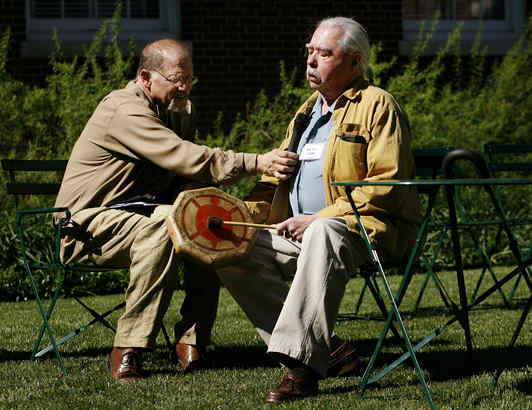
Below:  "Timothy Powell, director of special American Indian projects for the American Philosophical Society, holds a microphone for Watie Akins of the Penobscot Nation during Welcome Song." (Michael S. Wirtz/Staff Photographer)

Learners' dictionaries for Alaskan languages

Southeast languages focus of books

NATIVE:  Haida, Tlingit and Tsimshian words, phrases are included.

By Mike Dunham
Sealaska Heritage Institute has published a new series of learners' dictionaries for the Tlingit, Haida and Tsimshian languages and the first-ever Alaska Haida phrasebook.

"We've been working on language restoration for nearly 10 to 12 years, and I would say for a greater part of this we've been working on these dictionaries," institute president Rosita Worl said in a press release.

The new books incorporate some important innovations.

The "Dictionary of Tlingit," for instance, is the first to include nouns and verbs and all minor word categories in a single resource. The vast majority of the verb forms have never before been documented or published. It also includes example sentences for most of the entries, which illustrate the words in a context.

May 15, 2010

Instant messaging in Cherokee

Saving the language of the Cherokee

By Rob ReynoldsEach kid in the 4th grade classroom I visited was assigned a laptop equipped with a Cherokee keyboard. Like children everywhere, they were busy instantly-messaging each other—in Cherokee.

"They can use iChat and speak in Cherokee or they can converse with one anther in the syllabary on line," says Cherokee Nation's language director, Samantha Benn-Duke. "So, we will be revitalising the language in that manner."

Technology can be an outstanding tool to preserve and expand endangered languages, says Swarthmore College linguist K David Harrison, who works with the Living Tongues Institute.

"What we're seeing happening all over the globe is that small languages are levering the newest technologies. You can now have a small or minority language represented in an iPhone app, on a social networking site, and by putting these small languages out through these new technological channels—this is an amazing way to revitalise languages."
Below:  "Cherokee members at a museum in Washington."

May 12, 2010

Voter guides in Native languages

Federal Agency Issues Voter Guides in Native American and Alaska Native LanguagesCitizens who speak Navajo, Cherokee, Dakota and Yup’ik, the most commonly spoken Native American and Alaska Native languages in the U.S., will now have access to federal election voter guides in their native languages. Download the guides.

The U.S. Election Assistance Commission’s Language Assistance Program translated the guides to improve voting accessibility for Americans who speak these languages and have limited English proficiency.

April 29, 2010

Manitoba play in Métis dialect

Métis language to take centre stage at Le Cercle Molière

By Arielle GodboutThe closing play for next season at Le Cercle Molière theatre is already creating buzz—partly due to the fact the dialogue will be in French Michif, a dialect of Manitoba’s Métis.

It’s a first for the St. Boniface theatre company, which will premiere the new play next April.

"That is my understanding, that they’ve never focused on this language the way this play does," said the La Salle-based playwright, Rhéal Cenerini.

The play—Li Rvenant—takes place in a fictional Manitoba community of Métis fishermen.

The main character returns to his village after being exiled with a mission, Cenerini said.
Below:  "Rhéal Cenerini’s newest play, Li Rvenant, features substantial parts of the dialogue in French Michif, a dialct spoken by some Métis in Manitoba."

Saving Cree via Facebook

Poke from the future, protect the Cree past

Ernest Hester is using Facebook to help preserve his traditional language

By Zev Singer
Ernest Hester is trying to preserve the East Cree language, one Facebook posting at a time.

The Carleton University student, worried about the future of his language, which has about 13,000 speakers, decided a few months ago to start a Cree Facebook group.

For a small language to have any chance of survival, the key, obviously, is enthusiasm from young people.

Young people like Facebook. So far, more than 400 members have joined the group.
Comment:  For more on saving languages via Facebook, see Cherokee Language on Facebook.

April 22, 2010

This blog has moved

This blog is now located at http://pictographs.turquoisetales.com/.

You will be automatically redirected in 30 seconds, or you may click here.

For feed subscribers, please update your feed subscriptions to http://pictographs.turquoisetales.com/feeds/posts/default.

April 12, 2010

8th annual Oklahoma language fair

Eisenhower Elementary School’s studies help preserve American Indian languages

Children study to preserve American Indian languages

By James S. Tyree
Niigan Sunray, a third-grader at Eisenhower Elementary School, said she practiced 10 months to tell the story of "Tobi Ofi,” or white dog, in the dialect called Alabama Six-towns Choctaw.

If practice didn’t make perfect, it was close enough, as she won the individual spoken language contest Monday during the eighth annual Oklahoma Native American Youth Language Fair.

"It’s our migration story, from the west to the east,” Sunray said of a Choctaw band that moved back to the southeastern United States. "It was fun for me.”

Niigan is one of 636 children of all ages registered for the two-day language fair at the Sam Noble Oklahoma Museum of Natural History. Candessa Tehee Morgan, the event’s coordinator, said 25 American Indian languages will be spoken in 370 presentations.

April 03, 2010

Customer service in Cree, Inuktitut

RBC becomes first Canadian bank to offer indigenous languages telephone serviceRBC today announced the introduction of Cree and Inuktitut, two of the most commonly-spoken indigenous languages in Canada, to its multi-language telephone banking service. RBC is the first Canadian financial institution to offer telephone services in these languages.

Launched in 2008, RBC's multi-language telephone service has more than 2,600 specialized interpreters who help with day-to-day basic business and personal banking inquiries such as opening an account, paying bills or requesting foreign exchange information at no cost to the client. Interpreters are available to help translate 180 different languages.

"Canada is home to a variety of languages that many organizations do not recognize, or have the capacity to service through translation," explained Dale Sturges, national director, Aboriginal Banking, RBC. "We are pleased to be able to continue reaching out to an underserved market by incorporating Cree and Inuktitut into our customer service capabilities. RBC has a long history of building relationships with the Aboriginal community and we remain committed to finding innovative ways to partner with our clients to meet their financial needs."

March 21, 2010

Cherokee claymation language films

Videographer:  A portrait of Nathan Young IV

By Honey Dawn Karima PettigrewWhile emphasizing cultural studies and bilingual education in Native American languages, Young encountered Joe Erb, who taught him the techniques needed to create stop motion claymation movies. “I had the opportunity to work on ‘The Messenger’ to learn animation and I was lucky that Fort Gibson was so supportive in giving me the resources and freedom to learn,” he said.

Young, whose passion for Native American languages led him to pursue the study of Creek, Cherokee and Choctaw at the University of Oklahoma, viewed claymation films as an opportunity to educate and inspire. As part of the bilingual education program at Fort Gibson, Young’s students created short films, using the stop motion technique. These films shared traditional Cherokee stories, were performed in Cherokee (with English subtitles) by the students, who ranged in age from middle to high school level.
And:“I’m also working on a Pawnee language animation. I’m Pawnee/Kiowa/Delaware, and my Pawnee project is part one of a HAKO series that is called ‘Kits-pa-rux-ti: The Wonderful River.’” Young is eagerly anticipating the development of this series as a celebration of Pawnee culture.

“It’s the story of the origin of the Pawnee Medicine Societies. It’s not going to be a claymation, more like cell animation, actually drawn by frame. I’m just getting the language together now so that I can start animating.”

March 18, 2010

Ojibwe language learning software

Multi media company releases language learning software

By Kevin RoachGrassroots Indigenous Multimedia announces the launch of their new Ojibwe language learning software, Ojibwemodaa. The software application uses video conversations and engaging games to immerse the user in the Ojibwe language.

Mary Hermes, University of Minnesota professor with years of experience in education, and her husband Kevin Roach, an Ojibwe artist with expertise in tribal art and computer graphics, founded the nonprofit organization Grassroots Indigenous Multimedia (GIM) with the mission of developing materials designed to teach Ojibwe and other Native American languages.

GIM began recording videos of conversations between elders at language camps and other venues. For Ojibwe and many other indigenous languages, it is the everyday, conversational language that is least documented but most useful words and phrases for beginning learners. It was their original intention to simply publish the translated and transcribed videos on a website or youtube.

But in the process of applying for grants to support GIM’s work, Mary heard about Transparent Language from Ed McDermott at the U.S. Department of Education. He told them that Transparent had unique language tools and might be willing to let them use these tools to develop Ojibwe materials. Mary quickly contacted Michael Quinlan, CEO of Transparent Language, who offered his enthusiastic support, and a simple idea started growing into something big.

March 03, 2010

E-mailing with Cherokee keyboard

Letter perfect

Keyboard overlays help teach students the Cherokee language.

By Clifton Adcock
The e-mail was composed entirely in Cherokee syllabary.

Rachel and others at the Cherokee Nation Immersion School are the new keepers of their culture's fire, carrying into the information age the Cherokee language and its syllabary, created by Sequoyah nearly two centuries ago.

Although the font was created through an agreement between the tribe and Apple Inc. a few years ago, the students have a new tool to help type the language: a keyboard overlay that replaces the letters of the English alphabet with those of the 85-character syllabary.

Students had been using a variety of keystrokes on a standard keyboard to type in Cherokee, but now they can lay a thin black silicone pad over the standard keyboard to find the corresponding characters.
Below:  "Cherokee Nation Immersion School student Cambria Byrd chats with friends in the Cherokee language on her laptop Thursday. The school now has keyboard overlays to help students type using the Cherokee syllabary." (Adam Wisneski/Tulsa World)

February 21, 2010

Olympics broadcast in Native languages

Native voices bring Olympics home

Play-by-play commentary in aboriginal languages a labour of love, creativity

By Paul Watson
There is no word for seconds in the Mohawk language, which makes it especially difficult to call the action in an Olympic ski race live for television.

Tiorahkwathe Gilbert was the first among his people to broadcast Olympic men's super-G in his native language Friday afternoon.

A rookie to sports commentary, he has spent months training for the landmark moment. He's had long discussions with elders in coffee shops and at kitchen tables to agree on the best way to express things the Mohawk haven't had much cause to say before.
And:For the first time in Canadian history, the Aboriginal Peoples Television Network is providing play-by-play commentary of live sports in Cree, Mohawk, Ojibway, Dene, Inuktitut, Michif and Oji-Cree.

Most of the First Nations, Métis and Inuit broadcasters calling the Winter Olympics action for APTN are rookies recruited from communities across the country and trained by veteran sportscaster Jim Van Horne.

Van Horne's dulcet voice is familiar to fans of hockey on TSN. He has also broadcast from the Calgary, Sydney and Beijing Olympics. During the Vancouver Games, he's working from APTN's Winnipeg studios, mentoring the aboriginal broadcasters he coached.
Comment:  As with singing pop songs in Inuktitut, this may be the best way to preserve Native languages. Namely, by using them in everyday life. By employing them in the popular culture. By linking them to fun, engaging subjects such as music and the Olympics.

Below:  "Tiorahkwathe Gilbert, a commentator with Aboriginal Peoples Television Network, broadcast the Olympic men's super-G event in Mohawk." (John Woods/The Canadian Press)

February 18, 2010

Preserving Inuktitut with pop music

Popular music a way to preserve InuktitutA conference on northern languages in Iqaluit has ended with some participants urging territorial governments to use popular music as a way of promoting and preserving Inuktitut.

The Nunavut Language Summit examined ways in which music—and not the traditional throat singing or other ancient forms of entertainment—can help younger Inuit connect with their culture.

"Definitely, I think Inuktitut can be preserved through poetry, through songwriting, through every kind of writing there is," Juno award-winning performer Susan Aglukark, who sings in both English and Inuktitut, told CBC News.
Nearby Greenland proves this approach can work:Canadian delegates have cast an eye towards their neighbours in Greenland where young Inuk dance in clubs to lyrics in Kalaallisut, the Greenlandic language.

There are two major music labels on the island which boast music in the Greenlandic language from many genres: rock, hip hop and soul.

Local performers such as Chilly Friday and Nanook are treated like celebrities.

February 16, 2010

Printing books with Cherokee syllabary

Books to be printed in Cherokee syllabaryThe newest addition to Southwestern Community College's Oconaluftee Institute of Cultural Arts is actually a very old technology: a letterpress that will be used to print books in the Cherokee syllabary.

“We are bringing back the Cherokee history in true art form,” said Luzene Hill, OICA program outreach coordinator.

Years ago the Eastern Band published a newspaper called Tsa la gi Tsu lehisanunhi, or the Cherokee Phoenix. This first Native American newspaper was printed on a hot-type letterpress in which each word was put together by hand, combining individual metal letters or characters.

Through a $68,846 grant from Cherokee Preservation Foundation and a $47,792 grant from the Institute of Museum and Library Services, OICA will purchase a metal press and develop a print-making studio at its facilities on Bingo Loop Road in Cherokee.

February 12, 2010

Indian sign language endangered

Forum explores cultural language

By Kyle Turner Davis said NAISL was an alternate sign system that was conventionalized and distinct from other forms of communication. It is separate from gesticulation that co-occurs with spoken language and was used for hunting, rituals and other practices observing silence.

When asked if NAISL was created specifically for deaf people, Davis supported the possibility due to the historically higher percentage of hearing impaired among Native Americans. He said it has spread and evolved over time to become a complete language for others and not just the deaf.

Unlike monastic or occupational sign systems, NAISL is much more complex, Davis said.

Records indicate 12 language families and 40 spoken languages among the Native Americans but approximately only seven spoken languages in four linguistic families remain.
Comment:  For more on the subject, see Indian and American Sign Languages.

February 01, 2010

Web-based language tools

The Web Way to Learn a Language

By Eric A. TaubWith the growth of broadband connectivity and social networks, companies have introduced a wide range of Internet-based language learning products, both free and fee-based, that allow students to interact in real time with instructors in other countries, gain access to their lesson plans wherever they are in the world, and communicate with like-minded virtual pen pals who are also trying to remember if bambino means baby.

Learning a language sometimes seems as difficult as dieting. The solution is to figure out how to stay interested after the novelty wears off.

To counter boredom, online language programs have introduced crossword puzzles, interactive videos and other games to reward users for making progress.

Online courses are either fee-based, free or a combination. Starter kits of fee-based programs may cost just a few hundred dollars, but the cost to reach higher levels of comprehension and speaking can easily be $1,000.

Charter school teaches Ojibwe

Growing charter school teaches with culture, language

By Dan GundersonThe school Web site hosts video language tutorials produced by third-graders.

Kent Estey runs the media center, a small room crammed with computer equipment. He said the language videos are one way to connect the school with the community.

"So we have students actually teaching their parents and reminding their grandparents of the Ojibwe language that is lost," Estey said. "Technology is a wonderful tool."

The students also publish their own books and they just started a weekly podcast.
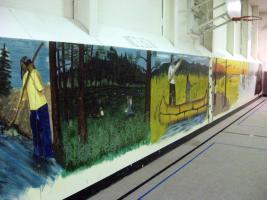
Below:  "Murals highlighting important traditional cultural events fill a wall in the school gym in Naytahwaush, Minn." (MPR Photo/Dan Gunderson)

January 28, 2010

Cherokee recognized for language initiative

Cherokee Nation receives Humanities Council AwardThe Cherokee Nation has been named the 2010 recipient of the Humanities in Education award for its significant contribution to the humanities in Oklahoma by the Oklahoma Humanities Council. The Nation was selected for the award in recognition of the tribe’s Cherokee language program and the Cherokee Nation Immersion School, according to a media release.

“We are honored to receive this recognition of outstanding achievement in a comprehensive Cherokee language and culture initiative,” said Dr. Neil Morton, group leader for Cherokee Nation Education Services. “The award brings special honor to the dedicated staff of the language program and to all the Cherokee Nation Group Leaders for their support of the Tribal Language Initiative.”

January 26, 2010

Rosetta Stone releases Chitimacha language

Rosetta Stone releases Chitimacha languageRosetta Stone Inc. today announced the release of the Chitimacha language version of Rosetta Stone® software for exclusive use by the Chitimacha Tribe of Louisiana. The last fluent Chitimach speaker died in 1940 but the tribe is trying to revive its language.

Rosetta Stone helps people learn a language by linking the meaning and structure of a new language directly to real world objects and events without translation. The Chitimacha language version of the software has been created through a Rosetta Stone corporate grant with all distribution rights belonging to the tribe.

January 09, 2010

Cherokee choir sings old favorites

Cherokee National Youth Choir release entertaining, educational

By Gary FifeThe award-winning Cherokee National Youth Choir announces the release of its latest music CD, “Learning as We Sing,” a project intended to both entertain and teach language skills. The new CD contains a variety of well-known traditional music intended for singing along, including patriotic American songs, Cherokee cultural songs, and even some Christmas songs.

“We’re extremely excited about this new album,” said Mary Kay Henderson, CNYC’s director.

Henderson said that the CD was designed to make learning Cherokee a little bit easier by using translations of familiar songs.

Listeners can sing along with the choir and learn old favorites such as “The Star Spangled Banner,” “This Land is Your Land,” “Twinkle, Twinkle Little Star,” “Jingle Bells” and “Frosty the Snowman,” all in the Cherokee language.

December 28, 2009

Cherokee language on Facebook

Cherokee language now on Facebook

By Christina Good VoiceCherokee speakers are starting to use popular Web sites to translate words, phrases and other parts of the language on the sites into Cherokee.

Cherokee Nation citizen Roy Boney is one of 14 translators on the social Web site Facebook who helps Cherokee people maintain ties to their culture by allowing speakers registered on the site to translate a glossary of common Facebook words and phrases. Their ultimate goal is to translate the entire site into Cherokee.

“As a citizen, I think it’s a wonderful opportunity for Cherokee to exist in a virtual space that’s a major part of the world community,” he said.

As of Dec. 17, there were 34,647 untranslated phrases on Facebook’s Cherokee translations page, 142 submitted translations and 14 active translators. Those translators are from areas in the CN jurisdiction, as well as Texas, California and other areas across the United States.
Comment:  Using social media to encourage language use is one of the methods I talked about at the Falmouth language summit in November. Glad to see someone else had the same idea.

December 26, 2009

Jana's American Indian Christmas

Christmas in 10 Native American Languages

By Monika EvstatievaFor weeks now, Christmas music has been playing everywhere—carols in the grocery store, holiday hits at Starbucks, and live music on the streets. But one artist has taken the holiday spirit in a different direction. Grammy-nominated singer and songwriter Jana Mashonee recorded 10 traditional Christmas songs in 10 different Native American languages. The result is American Indian Christmas.

"I wanted to do something no one else has done. And so I thought maybe I can do a whole album in Native languages," Mashonee says, "And I thought I am crazy; I am doing it."
And:There are over 500 different Native American tribes in the United States, but Mashonee, a Lumbee-Tuscarora, says often the elders are the only keepers of the languages. She recorded the album to make the Native language more accessible and accepted.

"It is kind of a way to know that these languages are still living ... to be able to have the younger people in the tribes to know more about their language and accept it," Mashonee explains. "And, also for non-Native people to hear a Native language."
Below:  Jana Mashonee's latest album is called New Moon Born. (Carter James)

December 16, 2009

Barona gives dictionary to NMAI

Tribes presents dictionary to NMAIThe monumental 696-page Barona Inter-Tribal Dictionary was presented to the National Museum of the American Indian (NMAI) and to the Bureau of Indian Affairs (BIA) during Native American Heritage Month. The dictionary is comprised of thousands of familiar as well as long-lost words and phrases aimed at assisting Yuman language speakers of the San Diego County Tribes in revitalizing their traditional native tongue.

A revised and enhanced version of the original 48-page Barona dictionary project, the expansive and updated edition contains a number of innovative features such as history of the project, biographies of the main contributors and a map of the language area.
Below:  From left to right: Barona Tribal Chairman Edwin “Thorpe” Romero, Barona Tribal Councilwoman Beth Glasco, Larry Echo Hawk of the BIA and Barona Tribal Councilmember Charles “Beaver” Curo.

December 11, 2009

Cherokee Language Bowl

Tribe announces Language Bowl winnersRecently 14 teams from several area schools displayed their knowledge and understanding of the Cherokee language as they competed for top honors in the Cherokee Nation’s annual Cherokee Language Bowl.

Coordinated by the tribe’s Johnson-O’Malley program, the competition is designed to promote the study, use and retention of the Cherokee language in young people. It is open to schools in the tribe’s jurisdictional area to students in grades kindergarten through 12 who are eligible to participate in the JOM program.

“Our cultural competitions were developed for cultivating the ground for students of the JOM program to know and understand more of who they are and where they come from,” Shelley Butler-Allen, CN JOM program director, said. “The Cherokee language is a very critical element for a student’s self identity and tribal identity, so we feel like these competitions help plant the seed for them and for their future.”

December 08, 2009

Immersion class for Cherokee employees

Video:  Cherokee Nation employees immerse in tribe’s language

By Christina Good VoiceCherokee Nation citizen Carla Feathers has a father who speaks Cherokee fluently. Although she’s not fluent, she always wanted to learn the language.

Now thanks to an initiative by the tribe’s Language Strategic Work Team, Feathers and other CN employees can immerse themselves in the language with hopes of learning it.

On Oct. 1, the tribe replaced a 20-hour language class for employees with a 40-hour immersion class. All employees will be required to take it as part of a core curriculum, according to a CN Employee Development e-mail.
Below:  "Ed Fields, left, speaks to Cherokee Nation employees in Cherokee during a 40-hour immersion course employees are required to take. Fields is a Cherokee language instructor." (Photo by Roger Graham)

December 07, 2009

Quechua-language TV station

Quechua language TV hits the airwaves in Ecuador

By Rick KearnsTV MICC Channel 47 of Ecuador became the country’s first Quechua-language community television station in July; it’s operated by the Indigenous and Campesino Movement of Cotopaxi (MICC) and will air 60 percent of its programming in Quechua.

The new station is located in the city of Latacunga, in north central Ecuador in an Andean basin that has a large Quechua-speaking population and is near many other indigenous communities as well.

On July 17, TV MICC hit the airwaves for the first time and reached 400 communities in the provinces of Cotopaxi, Tungurahua, Chimborazo and some parts of Pichincha and Pastaza in the east.

“We are interested in speaking about the earth and the water and about collective rights,” said MICC spokeswoman Maritza Salazar. “We want to make biographical documentaries to recover the historical memory of our men and women leaders. We want to speak about nature, and the struggles for water.”
Andean nations seek revival for ancient Inca tongue

By Walker SimonA shaman blows a bull's horn on festival day and pivots to clouds of burning incense in a purification ceremony, all shot on video.

The snapshot of native American life opens "Nukanchik Yuyay," a twice-daily newscast in Quechua, the language spoken by millions of people across the Andes and enjoying a revival as even presidents take up its cause.

The program's newscasters speak below a woolen tapestry of Cotopaxi, a glacier-capped volcano within sight of the station, Ecuador's channel 47. Besides the station's cameras, a wolf mask bares white fangs.

Based in Latacunga, 80 km (50 miles) south of Quito, Channel 47 says it is the world's first television station for Quechua speakers. On air since July, it features 30 percent Quechua programs and aims to go mostly monolingual as its audience increases.

"Our next project is Quechua cartoons ... to draw in children," says station manager Angel Tiban.

Language preservation using Twilight

A savvy Native language organization could spin Jacob Black's Quileute line in New Moon into an ad campaign. For details, see Language Preservation Using Twilight in my Newspaper Rock blog.

Below:  "I speak Quileute and 'Werewolf' too!"

November 30, 2009

Sidewalk plaques in Ohlone language

Reviving the language of a vanished tribe

By Carl NolteOn the south side of King Street, between the Caltrain station and AT&T Park, are 104 small brass plaques embedded in the sidewalk. On them are engraved all of the known words of a language called Rammaytush, the language of the people who lived for more than 1,000 years in what is now called Mission Bay.

There are words for numbers, words for relatives--brother, sister, my husband, my wife. Verbs: to drink (owahto), to eat (ahmush), to give (sume), to sing (harwec), to dance (irshah), to see (atemhimah), to run (othemhimah), to kill (meme). They are all that is left of a language, an explanatory plaque says, "the authentic voice of a vanished people."
And:But nothing is quite as simple as it seems. The people of Mission Creek have not vanished. Their descendants are around still--and they are attempting to revitalize the Rammaytush language and get their tribe--the Muwekma Ohlone--recognized by the government.

"There are thousands of us," said Andrew Galvan, who is a descendant of a Bay Miwok man named Liberato and an Ohlone woman called Obulinda who were married in Mission Dolores in 1802. Galvan is the curator of Mission Dolores and is not extinct.

October 31, 2009

Shi-Shi-Etko shot in Halq’eméylem

Residential school film plays Bay Street Film Festival

A film about a young girl’s final four days at home before going off to residential school aired Oct. 2 at the Bay Street Film Festival.

By Rick GarrickWhen Kroll first saw the children’s book Shi Shi Etko, which was written by Nicola Campbell, she realized she wanted to film the story.

“I came across the book by Nicola Campbell and could just visualize it in my head,” Kroll said, explaining she shot the film entirely in the Halq’eméylem language of the Sto:lo First Nation. “We got language coaches in, the actors were really dedicated.”

Kroll said the actor who played the Elder remembers being yelled at for speaking her own language while at residential school; only a few of the Elders now speak their language in the Chilliwack area of B.C., where the film was shot about a year ago.

“Only a handful of Elders speak the language anymore,” Kroll said. “I got to know about the language and the traditions of the people of that area. We wanted to keep the film as traditional as possible.”
Comment:  I haven't read the book or seen the movie, but it sounds like a good way to present the boarding-school story. Don't show the horrors of the boarding schools explicitly, because that only comes across as preachy. Imply the horrors by showing what the child is about to lose: her deeply-rooted culture and language.

For more on the subject, see Shi-Shi-Etko Trailer and Sto:lo Film of Children's Book.

Below:  "Kate Kroll, director of Shi Shi Etko, screened her film at the Bay Street Film Festival in Thunder Bay." (Rick Garrick--Wawatay News)

October 12, 2009

Apple computers with Cherokee font

Computer contribution helps preserve Cherokee language

By LeeAnn DreadfulwaterLiana Marquis of Richardson, Texas, contributed four Apple laptop computers valued at $4,000 to the Cherokee Nation Education Corporation with the stipulation that they be used for the Cherokee Education Language degree program at NSU. Marquis is a private citizen who has made several past contributions to the Cherokee Nation.

The biggest advantage for a Cherokee language learner is that every Apple computer sold since 2002 already has the Cherokee language font installed on it. Because the computers have the ability to type and display the Cherokee syllabary, they are a natural match for the NSU students, according to Gilliland. The computers will be available for check-out by the NSU Cherokee language program students.

October 09, 2009

Mi'kmaw board book for babies

Celebrating literacy and Mi'kmaq History Month with first Mi'kmaw board book for babiesIn celebration of Mi'kmaq History Month, the Read to Me! Program launched the Mi'kmaw version of Sheree Fitch's popular baby book Kisses Kisses Baby O!, translated by Mi'kmaw linguist Bernie Francis, and the Mi'kmaw edition of the Read to Me! bag at Indian Brook House of Learning today. The Mi'kmaw bag contains Weska'qelmut Apje'juanu (Kisses, Kisses Baby O!) and other books and reading resources for Mi'kmaw families. Weska'qelmut Apje'juanu is the very first Mi'kmaw board book for babies.

"It is important that our literacy resources reflect the diversity of culture and language in Nova Scotia," says Carol McDougall, Director of the Read to Me! Program. "I am excited to add the Mi'kmaw bag to our growing collection of literacy resources."

September 22, 2009

Golf signs in Ktunaxa

St. Eugene Golf renamed in Ktunaxa languageThrough a coordinated effort by staff and Ktunaxa elders, golfers at the St. Eugene Golf Resort Casino can now learn a few words in Ktunaxa as they play a round.

"We want to be more than a golf resort," said Dallas Ferguson, chief executive officer. "We want to be able to educate people on the Ktunaxa and aboriginal people as a whole. We see it as something unique we can offer as part of that whole experience you are just not going to find anywhere else."

Currently, the tee box markers throughout the golf course are being changed as the holes have been renamed in the Ktunaxa language—with phonetic spelling and translation. In keeping with the Ktunaxa culture, the nature of the course and the overarching environmental ethos of the resort, the hole names reflect far more than distance and shape. They show an intimate knowledge of the environment that developed over 10,000 years of aboriginal history and 11 years of first-hand experience with the course.
Below:  "Graeme Douglas, Dorothy Alpine and Richard Bellerose show off the new name tag at hole No. 2."

August 28, 2009

Ojibwe Language Weekend

American Indian Studies Ojibwe Language Weekend--'Ni'Shin!'

By Brita BrookesThe Michigan State Department of Linguistics & German, Asian, Slavic, and African Languages, The American Indian Studies Program, and the North American Indigenous Student Organization sponsored and organized the weekend event “Learning and Living the Language” which created an environment where students and community members could be immersed in the Ojibwe language. As language Professor Helen Roy communicated on the event flyer, “it is our duty and our inherent nature as Anishinaabeg to preserve the language of our ancestors.”

The Pow Wow which was held at a local community center meeting room was done completely in the Ojibwe language. Third year Linguistics Student Autumn Mitchell read aloud two stories in Ojibwe while a projection screen on the wall projected artful illustrations of the storyline.

August 12, 2009

Bemidji businesses post Ojibwe signs

Bemidji businesses including Ojibwe in signs

By Tom Robertson Shared Vision member Michael Meuers came up with the idea of asking businesses to post signs in Ojibwe. Meuers' goal was to get 20 businesses signed on to the idea in the first year. But in just six weeks, nearly 60 businesses are on board.

That includes big organizations like Bemidji State University, the City of Bemidji and the local hospital. It also includes smaller organizations like Harmony Foods, a downtown health food cooperative that will soon produce Ojibwe labels for the fruits and vegetables in its produce section.

Meuers works with local Ojibwe language experts to help businesses with proper usage and spelling of Ojibwe words. He said a local funeral home has asked for an Ojibwe translation for a blessing for grieving families. Other businesses have asked for translation help for words like "pharmacist" and "we fix computers."

The Shared Vision group is working on strategies for tackling a wide range of complex race issues. But Meuers said the Ojibwe signs are a simple gesture, and the first tangible sign of progress.

"It's profound in its simplicity, and it's inexpensive to do," Meuers said. "The thought occurred to me that Indian people would look at this as a welcoming and a sign of respect. The non-Indians in the community would learn a little bit about the indigenous peoples that have been here for thousands of years, and the tourists would love it, so there's an economic side of it, too."

August 03, 2009

Ktunaxa learning centers

Virtual elder rekindles hope for revival of Canadian aboriginal languageThe Ktunaxa have been digitally archiving their language since 1999 and they built their own broadband network in 2007 in order to make a better use of these language training resources.

The 7.7-million-Canadian-dollars (about 7 million U.S. dollars) Ktunaxa Nation Network is currently the only native-owned open-fiber-to-the-home net work in North America, providing speeds of 100 megabits per second to each home.

"We're now wired like no other community in North America," Maki sadi. "Not many people get a chance to change the course of predicted history, but with hard work and fiber, we will."

Four community learning centers has been set up in each of the Ktunaxa communities, all of them are equipped with high speed internet and vedio-conferencing devices. Specially trained staff there offer online educational classes or technical assistance to band members.

July 28, 2009

Cherokee phone-app video

Free Cherokee Language iPod/iPhone AppCherokee Lite (Free). Available on iTunes App Store now.

Thornton Media presents the FIRST EVER indigenous language iPod/iPhone App in the iTunes store. Available NOW! Free Cherokee Lite app, full version $9.99. Contact us to create one in YOUR language!

From the leaders in "Language Tools for Indian Country" (http://www.ndnlanguage.com).

Sci-fi film in Tsilhqot'in

Over in my Newspaper Rock blog I reported on a science-fiction movie being filmed in the Tsilhqot'in language. Check it out.

July 22, 2009

Language products for iPod and iPhone

Thornton Media, Inc.Thornton Media, Inc. creates custom hi-tech tools to help save endangered indigenous languages.

We are Native-owned and have worked with over 100 American Indian tribes and Canadian First Nations since 1995.
Thornton Media Inc.:  Our StoryA New Beginning...With Award Winning Products!

We continue to listen to our client's needs. TMI's clients were demanding a more flexible product at a lower price. By mid-2009, Thornton Media developed the Language Pal software to program Nintendo DSi specifically for language teaching. By August 2008, the decision was made to stop selling the defense technology because of rising prices and other issues. Thornton Media also responded by programming smaller hand-helds, creating iPod Touch/iPhone Apps, with many more features at a very low cost. Thornton Media will continue to finance the creation of programmable open-source software that would be available to tribes at no cost.
Comment:  I assume the "defense technology" refers to Thornton's Phraselator products.

July 09, 2009

First Salish graduating class

Nkwusm works to preserve Salish language

By Mark RatledgeNkwusm, a Salish Language immersion school on the Salish-Kootenai Reservation in Arlee, Mont. had its first graduation June 12.

Three boys and one girl, all 14 years old finished their language immersion program and next year will move into the public school system.

Located in an old bowling alley built in the late 1970s, the school has renovated the building into classrooms, and a capital campaign is in progress to raise funds for a new building. Inside, the classrooms look like any other school, except for the Salish alphabet on the walls and artwork depicting Salish cultural activities, and the sounds of children talking and singing in Salish. The school itself is operated by the Nkwusm Salish Language Revitalization Institute, a nonprofit formed in 2003 to research, promote and preserve the Salish Language.
Below:  "Patrick Pierre, 80, a Pend d’Oreille elder and fluent Salish speaker, who teaches at NKwusm, and Ma’ii Pete, 14, one of the school’s first graduating students in the class of 2009, are seen at Nkwusm’s graduation pow wow June 13." (Photo courtesy Mark Ratledge)

English/Ojibwe signage

From the Bemidji Pioneer, 7/8/09:

Ojibwe language:  Bemidji businesses adopt bilingual signage“Aaniin” “Boozhoo”--customers to Bemidji’s Cabin Coffee House & Café are now welcomed in both Ojibwe and English.

Table tents show them numbers, animals and the major Red Lake clans in both languages. And they can try their Ojibwe language skills to order makade-mashkikiwaaboo (coffee) and naboob (soup).

Noemi Aylesworth, Cabin Coffee House owner, said the idea came from Shared Vision, a Bemidji group working to make relations between American Indians and members of the majority culture more comfortable and friendly.
Below:  "Noemi Aylesworth, owner of the Cabin Coffee House & Café, holds a table tent listing the seven major Red Lake Nation clans in Ojibwe and English. Hers is the first business to go bilingual, but nine others have committed to the movement suggested by Shared Vision." (Pioneer Photo/Molly Miron)

July 07, 2009

Native language summer schools

Native language summer schools growingA new Navajo language summer school is being offered by Albuquerque Public Schools this year in New Mexico.

The program aims to help American Indian children in the area stay connected to their heritage and motivate them to achieve more academically.

The Santa Fe-based Indigenous Language Institute which tries to preserve native languages says New Mexico, Washington, Oregon and North Dakota lead the country in allowing Native Americans to teach their languages in public school classrooms.

Robert Cook, the president of the National Indian education Association, says native language schools are growing nationwide.
Classes aim to preserve urban Indians' heritage

By Heather ClarkOn his first day of the summer program, Lucas learned about the Navajo Code Talkers and how they confounded the Japanese during World War II by transmitting messages in their native language.

"That really drew him in right away," Mike Arviso said. "Because of the language, a single word has so many different meanings."

While many of the families want the instruction because of practical reasons, like enabling their children to speak with relatives in their native language, Thompson also sees long-term educational benefits.

Research shows that becoming disconnected from their culture leads to a lack of motivation among Native American students and can leave students behind academically, Thompson said.

For example, among New Mexico 10th graders taking the state high school competency exam, only 47 percent of Native American students passed the first time, compared with 77 percent of white students, according to state Public Education Department data for the 2007-2008 school year.

"If the Native American children feel that their culture, their language, their heritage is valued in the school, they will be very motivated," Thompson said.

June 14, 2009

"Eminence credentials" for Indians

Tribes reclaim languages once spoken in California

By Peter HechtLawmakers are moving on a bill to create a special American Indian languages teaching credential to promote efforts to teach–and recapture–some of the nearly 100 languages once spoken by California Indians.

The measure–Assembly Bill 544 by Democrat Joe Coto of San Jose–declares that "teaching American Indian languages is essential to the proper education of American Indian children."

The bill would also allow fluent speakers to teach special classes in public schools as part of understanding California history and culture.

The limited "eminence credential" could enable some tribal elders with little formal education to give lectures on ancient languages widely spoken before the Gold Rush.

June 13, 2009

Cherokee language through art

Video:  Cherokee Heritage Center exhibit celebrates Cherokee language

By Will ChavezCherokee artists who contributed artwork to the “Generations: Cherokee Language through Art” exhibit met each other and the public June 6 at the Cherokee Heritage Center.

For the exhibit, artists were asked to create a visual narrative of the Cherokee language using a different character from the Cherokee syllabary. The 93 artists who volunteered their time are from the Cherokee Nation, United Keetoowah Band and the Eastern Band of Cherokee Indians and range in age from 3 to 91.

“We have a very eclectic group of people, which is exactly what we wanted,” said CHC Museum Curator Mickel Yantz. He said artists used ink, paint, quilts, a television set, baskets, wood and ceramics to create 85 original pieces of work. “Just about every single medium you can think of we have on display.”
Below:  "Mickel Yantz, Cherokee Heritage Center Museum curator, aligns placards for artwork on display in the 'Generations: Cherokee Language through Art' exhibition at the CHC in Park Hill, Okla." (Photo by Will Chavez)

June 05, 2009

T-shirts promote Indian words

Entrepreneurial spirit lands MSU students in first place

T-shirt designs win American Indian business plan competitionFour students involved in the American Indian Business Leaders club at MSU Billings walked away with the best business plan among colleges in the organization’s annual national leadership conference in Arizona.

The team members included Mary Alice Walker, a member of the Winnebago Tribe in Nebraska; Curtis Wallette, a Northern Cheyenne; Karis Jackson, a Crow/Hidatsa and Angela Deputee, a Crow.

“At first, we didn’t think it was a good plan,” said Walker, a recent business management graduate. “But after we did our research, we found out we’re the only ones to have this idea.”

The “idea” was actually a formal business plan developed by the four students to turn an old building in Lame Deer into a T-shirt business. That business, called NDN Translations in the business plan, promotes awareness and pride in American Indian culture and heritage on T-shirts. The front of the shirt carries a single word or phrase in a specific tribal language with a little arrow pointing to the back for the translation.

While the concept seems pretty simple and tourist landscape is scattered with American Indian T-shirts, the students said their idea took things a step forward from the traditional images of famous elders, artwork of headdresses or bison. They provided a way to honor and celebrate their language with a word or phrase.

June 04, 2009

Haida language animated videos

Two stop-motion videos on the Haida Nation website teach the Haida language in a fun way.

Yaanii K'uukaYaanii K’uuka jaada dagangaas gaa diidsee jaadaa xagaa, Yaanii K'uuka
gan kagan dee. Gudangang isgyaan yaalang gee sahlgang iisgaay gudangang.

A spoiled young girl is taken by the wild forest-woman, Yaanii K'uuka
and must find a way to escape and make her way back to her parents.
The Golden Spruce

Comment:  For more on the subject, see Native Videos and Cartoons.

May 13, 2009

Learning Arapaho in the park

Kids get language immersion at Arapaho schoolThe 20 or so pupils of the school that allows only Arapaho language spoken within its walls in Arapahoe took a recent trip to the park to play and learn.

"It's part of the immersion. We're bringing them to the outside to expose them to the trees and the grass," Hughes said.
And:The teachers took their preschool through first-grade pupils to Jaycee Park in Riverton for more exposure to nature and the tribe's language outside of the classroom environment.

Hughes recalled the children's interaction with Arapaho language on the playground, "telling each other 'I want a drink of water' or 'I need to go to the bathroom,' things they know."
Below:  "Northern Arapaho tribal elder Laura Shakespeare rests under the shade of trees at Riverton City Park recently, while Arapaho Language Immersion School students Ilana Anderson and Dimikko Yellowbear, both 3, play nearby." (Martin Reed/Riverton Ranger via AP)

April 09, 2009

7th annual Oklahoma language fair

Language fair has drama in Norman

By Tami AlthoffMost of the audience couldn’t understand the language, but they certainly knew what was going on Tuesday when Cushing High School students presented "Sauc Pre-K in 2011” at the seventh annual Oklahoma Native American Youth Language Fair at Sam Noble Oklahoma Museum of Natural History.

Despite the language barrier, the content of the skit was universal.

"It was about stuff that would normally happen in a pre-K class,” Sydney Gabbard, a Cushing High School senior, said. "The language we were speaking was Sauc.”
And:More than 500 participants, in pre-kindergarten through 12th grade, attended the language fair Monday and Tuesday at the museum. Coming from Oklahoma and other states, they competed in categories such as spoken word, dance, music, film and essay.

The event is the largest American Indian youth language fair in the country, featuring an estimated 24 languages.

Candessa Tehee Morgan, coordinator of the fair, said the event gives students a chance to learn and practice their native language.

April 06, 2009

Native films help preserve languages

Saving Native American languages[Elizabeth Weatherford is] director of the Native American Film and Video Festival which celebrates its 30th anniversary this year.

Dozens of native language films are being shown, including the first to be written entirely in Alaska's Inupiaq language.

Sikumi/On the Ice, by Andrew Okpeaha Maclean, premiered at the Sundance Film Festival and was short listed for an Academy Award.

"Anything that can activate young people who have been saturated by the American media is really important," says Ms Weatherford.

"Film making can make them empowered by the use of language in their own world. It's the transmission of language through culture and there's an effortlessness to it."
Below:  "Sikumi is the first film to be written entirely in Alaska's Inupiaq language."

April 05, 2009

Minnesota efforts need coordination

Indian leaders, lawmakers try to save languages"Our Ojibwe language is officially in a state of crisis," Jourdain said. "We estimate that there are as few as 300 fluent language speakers remaining within our tribe. Our official tribal enrollment number is 9,397 members."

His tribe, like many others, is working on the issue, with a recent study resulting in a five-year plan to protect the language.

"This brings us one step closer to establishing a language immersion program on the reservation focusing on children and families," he said.

But Native Americans talking to legislative committees said coordination is needed, including with the state education system.

"We are all recreating the wheel," said Marisa Carr, who has translated school books into Dakota and Ojibwe.
And:Turning the tide is the goal of legislative bills sponsored by Olson and Rep. Kent Eken, DFL-Twin Valley.

The bills' bottom line is to create an inventory of existing language programs on the 11 Minnesota reservations, including school curriculum, and find ways to spread Indian language education.

March 30, 2009

Dakotah children's books and Scrabble

AAIA program saving endangered Native languages with translated children’s booksWhen elder Orsen Bernard sang to children in the Dakotah language, DeCoteau saw the need for teaching materials in Dakotah. “We realized that no matter how much you spoke in the language, everything else was in English. Every book, every song, every movie was in English. So we started creating materials to view in the language programs and schools.”

Although the program is in its infancy, in just a few years time, DeCoteau’s efforts have led to the creation of more than 60 children’s books, videos and CD’s in the Dakotah language. The program also created a Dakotah language Scrabble game, a rap CD, computer applications and a theatrical play.

DeCoteau also noted that other tribes wanting Scrabble in their Native languages could have them created. “We talked with the people at Hasbro and they said they would be happy to work with the AAIA to create them.”

Her unique and contemporary techniques for teaching Native languages are creating such positive results that other tribes are beginning to follow suit. She said the process is simple. “It’s all on Microsoft Publisher, we send the tribe the disc, they just delete the Dakotah language, add theirs and then print it out.”

March 11, 2009

Flashcards, classes, and audiotapes

Menominee tribe makes effort to keep language aliveUsing a booklet of flashcards held up by their teacher, the 2-year-olds pointed and repeated the words kuapenakaehsaeh (cup), aemeskwan (spoon) and paeces kahekan (fork). At home they've been known to ask their families for a snack using the Menominee words for crackers and fruit instead of English.And:The average age of the few dozen remaining native speakers is in the mid-70s, and some of the elders who speak the language are in ill health. However, the tribe has 10 trained Menominee language instructors who teach in the schools and College of Menominee Nation. The language is taught in day care and kindergarten through middle school. At the high school, it's a popular elective taken by three-quarters of the students.And:The [language and culture] commission trains substitute language teachers, works on language curriculum and helps with a University of Wisconsin-Madison project compiling a beginner's dictionary of the Menominee language. The tribe has also converted hundreds of hours of audiotapes of elders speaking stories, which were recorded decades ago, into digital versions that can be downloaded on iPods and laptops.

March 10, 2009

Film about Inupiaq language

Films tells Inupiaq history[Rachel Naninaaq Edwardson's] second film, "The Voice of Our Spirit," presents viewers with individuals, young and old, who struggle with the loss of language in their own personal way.

"The film chronicles a history that spans 150 years," said Edwardson during a video call from her current home in Melbourne, Australia. "It starts with the epidemics, then the missionaries and the boarding school. It provides a historical understanding of how it happened that no one speaks the language."
And:Until now, the School District never taught Inupiaq language and culture in a systematic way, according to Harcharek, most likely because no materials existed. That is already changing thanks to programs and a curriculum developed by Harcharek and fellow educators. Edwardson's films are a big part of the process.

An Anchorage anthropologist, historian and curriculum developer, Patricia Partnow, is currently working with the films to develop learning guides that will accompany them in classes and place them in context with the history the students are taught.

March 03, 2009

ILI wins Tech Savvy Award

The Indigenous Language Institute Wins National Verizon Tech Savvy AwardThe Indigenous Language Institute's Intergenerational workshop series is the national winner of the Third Annual Verizon Tech Savvy Awards.

Through the workshop, entitled Ancient Voices, Modern Tools: Native Languages and Technology, the institute instructs families, students and teachers on how to use technology to develop print and audio books to teach Native American languages at school and home. The institute, which is based in Santa Fe., N.M., and serves 2,000 Native Americans annually, will receive a $25,000 grant to continue and expand its program.

February 21, 2009

Atlas of dying languages

New atlas shows dying languages around the worldIn a presentation Thursday of a new world atlas of endangered languages, linguists stressed the list is not restricted to small or far-flung countries. They also sought to encourage immigrants to treasure their native languages.

"Language endangerment is a universal phenomenon," said Christopher Moseley, an Australian linguist who edited the atlas' third edition, which is to appear in digital and paper versions.

The atlas says 200 languages have become extinct in the last three generations, and another 199 languages have fewer than 10 speakers left.

More than a fourth of the 192 languages once spoken in the United States have disappeared. Another 71 are severely endangered, according to the atlas.

February 16, 2009

Ojibwe Language Weekend Pow Wow

American Indian Studies Ojibwe Language Weekend–“Ni’Shin!”The Michigan State Department of Linguistics & German, Asian, Slavic, and African Languages, The American Indian Studies Program, and the North American Indigenous Student Organization sponsored and organized the weekend event “Learning and Living the Language” which created an environment where students and community members could be immersed in the Ojibwe language. As language Professor Helen Roy communicated on the event flyer, “it is our duty and our inherent nature as Anishinaabeg to preserve the language of our ancestors.”

The Pow Wow which was held at a local community center meeting room was done completely in the Ojibwe language. Third year Linguistics Student Autumn Mitchell read aloud two stories in Ojibwe while a projection screen on the wall projected artful illustrations of the storyline. Autumn has been a student of Helen Roy’s language teachings since Middle School. Autumn read two stories “When you Give a Mouse a Cookie” and my favorite “When you give a Mouse a Drumstick.” Already with extensive language training for her age, Autumn will be graduating in a year and a half and will be able to utilize her skills in continuing the legacy of promoting the language.

January 13, 2009

Passamaquoddy-Maliseet dictionary

Natives, educators hail release of dictionaryPerley estimates that less than two per cent of the 5,000 Passamaquoddy- Maliseet people living in a handful of communities in New Brunswick, Maine and Quebec are fluent in their native tongue.

But her ongoing struggle to preserve and restore the language to common use has been given a major boost with the release of a Passamaquoddy-Maliseet dictionary.

Authored by David A. Francis, a former tribal governor from Maine, and Robert A. Leavitt, a former member of UNB's faculty of education, the book represents 30 years of collaboration between native speakers, educators and linguists.

Its more than 18,000 entries contain remarkable detail about the physical, spiritual, social and emotional environments of the Passamaquoddy and Maliseet peoples, who called most of the region home before the arrival of European settlers.

When It's Gone It's Gone recognized

Norman students hope film helps rescue native tongues

Norman club interviewed tribal elders for award-winning language documentaryA documentary about the dying languages of American Indian tribes has received state honors for a group of Norman students, and is being used in classrooms as a teaching tool.

Students in Norman High School’s Native American Club were recognized recently by state Education Department officials for their documentary, titled "When It’s Gone, It’s Gone.”

The students interviewed tribal elders representing American Indian tribes in Oklahoma and asked them about their native languages and the struggle to keep their languages and cultures alive.

Most of the elders on the video are in their 80s and have witnessed the languages of their tribes dying out as the younger generations were raised in an English-speaking society.

December 15, 2008

Ojibwe via interactive TV

Ojibwe by ITV:  Bena school delivers classes to Deer River, RemerAs high school students arrive in Andrew Jackson’s classroom for Ojibwe language classes each afternoon in Bena, students miles away in Deer River and Remer also meet for Jackson’s classes.

This fall, Bug-O-Nay-Ge-Shig School started delivering two Ojibwe classes via interactive television to students at Deer River High School and Northland High School.
And:During the two classes at Bug-O-Nay-Ge-Shig School, Jackson and the students in his classroom can see and hear the students in Deer River and Remer on a television. The TV screen is split, with the Remer classroom on top and the Deer River classroom on bottom.

A second television in Jackson’s classroom reflects the sights and sounds of his classroom–the same sights and sounds transmitted to televisions in the two classrooms in Deer River and Remer.

Jackson sends handouts and assignments to students in Deer River and Remer by e-mail, and the high schools send the students’ completed assignments back to Jackson.

Lushootseed in public schools

Teaching Indian languages preserves heritage, tooIn Washington, tribes have formed partnerships with school districts and the state to reach tribal and nontribal kids in public schools. As of the 2006-07 school year, 14 instructors were certified by tribes to teach language in the public schools. Tribes work with school districts to fit language classes into the school day.

"It's a priority," said principal Teresa Iyall-Williams at Tulalip Elementary. Language instruction boosts native students' achievement, she said. "It increases engagement when they are able to see themselves in the curriculum."

Non-Indian students benefit, too: At Port Angeles High School in Clallam County, where the student body is about 97 percent nonnative, Lower Elwha Klallam language instructor Jamie Valadez has since 1999 taught Klallam as one of the elective languages any student can take. Her classes are made up not only of students from Lower Elwha and other tribes but nonnative teens curious to learn.

"It is just something they are interested in and enjoy, they are fascinated with learning about the native culture," Valadez said.

Learning another language also hones her students' knowledge of English grammar and syntax, which they use to decode and build sentences in Klallam.

December 03, 2008

iRez Language Pal debuts

Language Learning Gets More High-TechThornton Media, Inc., a Indian-owned firm based in Banning Calif, plans to launch two new Native language learning products at the 2008 National Indian Education Association Conference, held October 23-26 in Seattle, Wash.

The first is a hand-held language teacher called the iRez Language Pal. The device is much like Phraselator, a hand-held device developed by Voxtec to help troops serving in the Middle East translate Arabic words to English. It records and translates audio and video files and stores language via a flash memory card, holding up to 85,000 phrases and words.

Thornton Media adapted the product for Native language instruction and marketed it to tribes for about three years. But the $3,300 price tag limited accessibility. It decided to develop a more affordable product.

Offered at a quarter of the cost, iRez Language Pal is smaller and more advanced. It comes with a half dozen new features, like crossword puzzles, flashcards and a car tutor system.

University offers Cherokee course

Cherokee Language to be offered at Rogers State UniversityBeginning in the spring semester, Rogers State University will offer Cherokee language courses on its Pryor campus.

Cherokee I will begin in January at the start of the spring 2009 semester and Cherokee II will be offered in the fall. The university plans to continue the course rotation each year. The Cherokee language courses are open to both degree seeking and non-degree seeking students. Students can take the course as part of the minor in Native American Studies or to fulfill a general education requirement.

“We are located in the Cherokee Nation, so it is only natural that we offer Cherokee language classes,” said Dr. Hugh Foley, associate professor and coordinator of Native American Studies at RSU. “This is part of our continued development of American Indian Studies at RSU.”

November 25, 2008

The thinking behind RezWorld

Native company launches video game to teach endangered languages, culturesLike in other interactive games such as Grand Theft Auto and The Sims, the player controls the main character in the game.

“Imagine a world inhabited by intelligent virtual humans that speak only your Indigenous language,” said Don Thornton, TMI’s Chief Executive Officer. To reach the game’s goals you must communicate with other characters that recognize not only your language but also your gestures and behavior. The game teaches languages in context and also cultural protocols based on character behaviors.

Thornton Media, Inc., the creative minds behind the RezWorld™ 3-D video game was the first company to offer customized hi-tech tools to revitalize Native languages. Since its launch in 1995, it has become the recognized leader in the industry. TMI, a Native-owned company with more than 100 tribal clients in the United States and Canada, has invested over six-figures into the game.

“The reason I am so aggressive about saving indigenous languages is because I am a Cherokee Nation citizen and the Cherokee language is in worse shape than ever,” Thornton said. About five years ago, there were 15,000 speakers, now there are only about 6,000. A Cherokee language department staff member recently remarked, “Some weeks we lose 100 speakers. Think about the language situation in 10 years.”
Comment:  For more on the subject, see Video Game Teaches Languages and More on RezWorld.

November 21, 2008

Menominee talking circles

Menominee language finds new life in schools

Tribe committed to preserving conversational skillsEveryone must participate in Margaret Snow's "talking circle" when the fifth-graders introduce themselves using the Menominee language—that's a rule.

Some students easily pronounce the words, repeating their name, clan and hometown as quickly as they can recall it. But it's more of a challenge to others who may not have been as exposed to the native language.

"I just want them to try," said Snow, one of two language teachers at Keshena Primary School. "With these words they can communicate with each other, so it's important they have a chance to show they can remember their introductions."

Snow's third-grade students learn to talk about the weather in the Menominee language, and then recite a traditional prayer. Her fifth-graders focus on their conversational skills.

November 16, 2008

Cherokee documentary on PBS

PBS to do documentary on Cherokee language programA program that teaches the Cherokee language to Cherokee children will be featured in a PBS documentary.

A film crew and producer for "We Shall Remain" were in Tahlequah Thursday to visit the Cherokee Language Immersion School and interview Principal Chief Chad Smith and others.

November 13, 2008

Lakota language summit

Fluent Lakota speakers running out of time

Symposium searches for ways to preserve Native languages.At Tuesday's opening of a three-day summit about revitalizing their languages, the Native American speakers needed English at some point to communicate.

"We're really in a race against time," said Ryan Wilson of the National Alliance to Save Native Languages.

The Lakota, Dakota, Nakota Language Summit: Uniting the Seven Council Fire to Save the Language has brought together a mix of 400 Native American educators, language experts and traditional fluent speakers. They are here to determine how to keep their languages from disappearing.
And:On Wyoming's Wind River Reservation, people in the Arapaho Tribe counted on teaching the language in school, similar to how math and other classes are taught in a system approved by federal and state regulators.

"After 35 years of teaching at Wind River, not one student is a fluent speaker. These methods, ... they're not working," Wilson said.

Wilson said his stepfather saw the answer to capturing fluency by teaching children in a language-immersion school. With Wilson's help, an immersion school was funded, built and opened in 12 months. But it wasn't easy.

November 11, 2008

When It's Gone It's Gone

A documentary filmed and produced by the Norman High School Native American Club. It examines the dying languages of Native Americans through the eyes of our Elders.Comment:  This video is long (17 minutes) but watchable. Considering it was put together by high-schoolers, it's pretty polished. I'm not sure you'll learn anything new about language preservation, but it's interesting to see people and places that usually aren't featured in Native films.

October 21, 2008

Arapaho Language Lodge

Its Native Tongue Facing Extinction, Arapaho Tribe Teaches the Young About 22 children from pre-kindergarten through first grade started classes at the school—a rectangular one-story structure with a fresh coat of white paint and the words Hinono’ Eitiino’ Oowu’ (translation: Arapaho Language Lodge) written across its siding.

Here, set against an endless stretch of windswept plains and tufts of cottonwoods, instructors are using a state-approved curriculum to teach students exclusively in Arapaho. All costs related to the school, which has an operating budget of $340,000 a year, are paid for by the tribe and private donors. Administrators plan to add a grade each year until it comprises pre-kindergarten through 12th-grade classes.
And:A group of Arapaho families had sent their children to a pre-kindergarten language program for years, but it was not enough. Heeding Ms. Cedar Tree’s words, the tribe began using Arapaho dictionaries, night classes, CDs made by the tribe, and anything they could find to help resuscitate the language. In the end, “we knew in our hearts that immersion was the only way we were going to turn this around,” said Mr. Wilson, a member of the Oglala Lakota tribe.

“Language-immersion schools offer an environment that goes beyond teaching the language,” Ms. Slaughter said. “It provides a safe place where a child’s roots are nurtured, its culture honored, and its being valued.”

October 03, 2008

Building a house of language

North Slope Inupiaq language teachers stress oral fluencyOver the last several years all of the Inupiaq teachers received training in the accelerated second language acquisition methodology from Dr. Stephen Greymorning, professor of Native American Studies at the University of Montana.

The technique developed by Greymorning employs the use of images to teach in a unique system designed to build a “house of language.”

Teachers use images to teach a sequence of skill sets that require learners to produce the language, and facilitate the internalization of the way the language works.

The method requires that teachers speak only in the language when they are working with children. Translation into English is not allowed which means that teachers need to use the images, as well as gestures and body language, in order to facilitate comprehension.

September 24, 2008

More on RezWorld

Immersive video game aims to revitalize American Indian languagesIndian kids will soon have a Super Mario-like character of their own to guide through an array of digital puzzles and game landscapes. But instead of a character who looks like the mustached Italian plumber, made popular from appearances in dozens of Nintendo offerings, a new video game created by a Native-owned company will feature tribal characters speaking a variety of Indian languages.

The game, called RezWorld, is billed as the first fully immersive 3-D interactive video game that can help young Indians learn to speak their own languages via a unique speech recognition component.

“We’re all about teaching Native language in a context that really engages our young people,” said Don Thornton, the Cherokee owner of the California-based Thornton Media, which has led the way in creating the game’s prototype.
Comment:  For more on the subject, see Video Game Teaches Language.

Declaration for Anishinaabemowin

Putting Anishinaabemowin firstAn alliance of Anishinaabe tribal leaders and citizens from Canada has put forth a declaration asserting that Anishinaabemowin is their primary language.

The declaration, which was approved by the Walpole Island First Nation of the Bkejwanong Territory in August, says that immersion and fluency in the Anishinaabemowin language is a long-term goal for all of its citizens.

September 18, 2008

Smithsonian has stuff

Drafting a FutureDuring his getting-acquainted tour of the Smithsonian, G. Wayne Clough, the institution's new secretary, was stopped in his tracks by a group of researchers poring over pages of "endangered" languages.

Clough sat there in the reading room of the National Anthropological Archives in Suitland, one of the many outposts of the Smithsonian empire, and heard how experts at the institution have been collecting languages since before the Smithsonian was the Smithsonian.

This group handed him some cards. He undid the white ribbon and found slips with words from the Poosepatuck Nation. Clough recalled he was a little flabbergasted when Robert Leopold told him these were 19th-century copies of a set that Thomas Jefferson had written on a trip to Long Island in 1791. And Clough (pronounced "cluff") said he was even more impressed when he visited a laboratory and saw that 8,000 pages of Cherokee had been digitized and shared with North Carolina tribe members who wanted to teach their children the language.

August 17, 2008

Hualapai language camps

Language camps help tribes keep languages aliveAbout 80 youngsters are camped in tents for the program at Hualapai Mountain Park.

They rise at 5 a.m. for a hike, followed by language sessions. One "master" uses pantomime to teach a Native game similar to street hockey, then asks kids to describe the actions in Pai terms. Others teach how to make arrows, gourd rattles and a drink from sumac berries.
And:Because language frames the way a person looks upon the world, Watahomigie said, its demise also threatens a tribe's values, traditions and religion.

That reality is magnified by the dominance of pop culture among kids.

"A lot of these kids here, they don't even think they're Indians. They're like everyone else," she said. "We have a lot of gangs, a lot of drug abuse, right now. Much of that is because children don't have a good self-concept. It's important for them to be proud of who they are, to respect themselves, to understand that they are a unique people but also part of a whole."

Nearby, two girls share an iPod. They appear to be ignoring their pottery instructor, but it turns out that the music in their ears comes from a traditional Hualapai singer.

August 14, 2008

Video game teaches language

RezWorld™--The 3D Interactive Video Game that teaches YOUR Native languageThornton Media, Inc., the leaders in "Language tools for Indian Country", presents RezWorld™, the first fully-immersive 3-D Video Game that teaches Native languages.

The game teaches spoken language and cultural knowledge. Students learn by playing fun, immersive 3D video games that simulate real life social communications. It involves "intelligent virtual humans" that recognize the trainee's speech, gestures and social behavior.

The technology was developed by academic scientists and has been used successfully by language learners. Extensive testing by third-party researchers measured positive learning results (May 2007).

August 04, 2008

Paid to speak Oneida

Saving Oneida language becomes a full time jobIndian tribes across the country are taking steps to preserve their native languages. The Oneida Indian Nation of New York has made it a full-time job, paying tribal members what they would earn in other jobs to immerse themselves in the nation's spoken word.

"We've had language programs here for a long time," said Sheri Beglen, a teacher in the Oneida's program. "But they were once a week for adults, or a half-hour after school for kids. You just can't learn a language one day a week.

"To learn a language, you have to hear it, use it constantly," said Beglen, who was among the first eight graduates of the Oneida program, now in its fourth year.

Gerald Hill, president of the Indigenous Language Institute in Santa Fe, N.M., said while virtually all the more than 300 recognized American Indian tribes have some type of language program, they vary dramatically in approach and effectiveness. Hill said he was unaware of any other tribes paying members to learn the language as a full-time job.

July 30, 2008

Rediscovering the Navajo Language

Putting a language into perspective

New Mexico first state to adopt Navajo textbookState officials formally adopted Yazzie's book, Diné Bizaad Binahoo'ahh, or Rediscovering the Navajo Language, on Tuesday in Santa Fe. While other books on Navajo language exist, state officials say New Mexico is the first to adopt a Navajo textbook for use in the public education system.

About 10 school districts in New Mexico provide Navajo language instruction. Out of seven American Indian languages that were taught in the public school system during the 2006-07 school year, 5,024 students were learning Navajo.
And:School districts in New Mexico, as well as U.S. Bureau of Indian Affairs schools, can review Yazzie's book and decide whether to use it starting in the 2009-10 school year. The book will be accompanied by a compact disc with the voices of Yazzie and her brother, Berlyn Yazzie, a former educator and administrator on the Navajo Nation.

In the Navajo culture, certain topics—such as how to build a hogan or cradle board and how to care for cattle and horses—should be addressed by men. Other topics, including the preparation of food, clothing and caring for children, should be addressed by women.
And:Each chapter of the book, which Yazzie said is suitable for students of all ages, begins with a cultural lesson and guides readers through verbs, sentence construction, clanship, clothing, formal education, telling time the Navajo way, the reservation, Navajo teachings, corn fields, livestock, textures, shapes and the Navajo government.

It also includes pictures of people who have lived on the Navajo reservation, which stretches into New Mexico, Utah and Arizona. Yazzie said she looks forward to students sharing the book with Navajo elders and "pretty soon conversation will be sparking around fires."

July 21, 2008

Diné summer language camp

Elementary students participate in Dine summer language campElementary school children in Bloomfield are breaking away from their TVs this summer to learn about the history and culture of the Navajo people—in a class conducted entirely in the Navajo language.

The Diné Language Immersion Program, for students in kindergarten through sixth grade, runs from July 7-30 at Central Primary School in Bloomfield. The course lasts all morning, from 8:30 until noon, Monday through Thursday.

"I was just watching TV all day," said 10-year-old Zachary Augustine, referring to his summer before the class and why he decided to attend.

July 10, 2008

Ojibwa songs as teaching tools

Native American language classes aren't just talk

Heritage is at the heart of the lessonsHis songs don't make the American Top 40. Instead they have a more useful purpose: To help keep children of American Indian descent connected with the language of their heritage.

Taylor, a Walpole Island resident whose Ojibwa name is Kaangaadese, uses songs he writes as part of a class he teaches in American Indian language Wednesday nights at Algonac Community Center.

"I like to teach every day language using native language songs," Taylor said. "It is a good teaching tool."